 Donate
 Alumni
 Login & Email


 If you have your Bachelor of Science in Nursing (BSN) and are interested in pursuing a terminal degree in the nursing field, then you may want to consider a BSN to DNP program to help you achieve your goals.
In a growing number of states, DNP-prepared Family Nurse Practitioners can diagnose, treat, prescribe, and manage patient care with the same autonomy as a physician. This article breaks down what FPA means, how state laws vary, and exactly how NMC's BSN to DNP program prepares you for it.
By understanding full practice authority for nurse practitioners and how a BSN to DNP program can prepare you for these responsibilities, you can determine whether this path may be right for you.
Understanding Full Practice Authority (FPA) for FNPs
According to the American Association of Nurse Practitioners (AANP), Full Practice Authority means NPs are authorized to:
- Evaluate patients independently
- Diagnose acute and chronic conditions
- Order and interpret diagnostic tests
- Initiate and manage treatment plans
- Prescribe medications (including controlled substances)
Nurses are authorized under the exclusive licensure authority of the state board of nursing to complete these tasks without requiring physician oversight or a collaborative agreement.
Currently, more than half of the states and territories in the United States offer FPA for nurse practitioners. You can explore the AANP's interactive State Practice Environment map to see which states offer FPA.
The Three Levels of NP Practice Authority: By State
The range of a nurse's responsibilities and powers is often referred to as the scope of practice. However, a nurse's scope of practice can vary throughout their career, especially as they advance their education or as state/federal policies evolve.
When it comes to FPA for nurse practitioners, states fall into one of three categories: full practice, reduced practice, and restricted practice.
Full Practice
In full practice authority states, NPs can carry out the same roles and responsibilities as physicians. This includes evaluating and diagnosing, ordering and interpreting diagnostic tests, and prescribing medications (including controlled substances).
Examples: Nebraska, Colorado, Oregon, Washington and 27+ other states/territories
Reduced Practice
Some states, such as Indiana and Ohio, offer reduced practice for NPs. This means NPs face restrictions in at least one aspect of their practice and must maintain a long-term collaborative agreement with a physician or other healthcare provider to continue offering care.
Restricted Practice
In some states, such as Texas and Oklahoma, NPs' autonomy is further reduced. Under restricted practice, NPs are limited in the care they can provide without career-long supervision or delegation from a physician or other healthcare provider.
Important note: Practice authority laws change frequently as states expand NP scope. Always confirm the current regulations in your state before assuming FPA status and factor this into your career planning if you're considering relocating. Use the AANP State Practice Environment map for the most current picture.
Why Choose a BSN to DNP Pathway?
If you already have your BSN, then you know you have plenty of options when it comes to advancing your education. So, what makes a BSN to DNP such a desirable path for many in your situation?
Advanced Clinical Expertise and Knowledge
For starters, consider the fact that a BSN to DNP program empowers you to build extensive clinical expertise, knowledge, and experience to advance your career prospects and obtain your terminal degree in as little as 3-5 years. After completion of your BSN to DNP program, you'll be eligible to sit for certification as a family nurse practitioner (FNP) while being prepared to develop, implement, assess, and advance new practice approaches for healthcare delivery.
Leadership and Policy Training
A BSN to DNP program will also include a leadership component to prepare future FNPs for the challenges and trials of working with full practice authority. With coursework covering such important topics as environmental health and public health policy, as well as informatics and leadership, you can be prepared to take on leadership roles with confidence.
Key Components of a BSN to DNP Program for FPA Preparation
Not all BSN to DNP programs prepare you equally for independent practice. When evaluating programs, look specifically for these two components and see how NMC delivers on each:
Clinical Practice and Patient Care
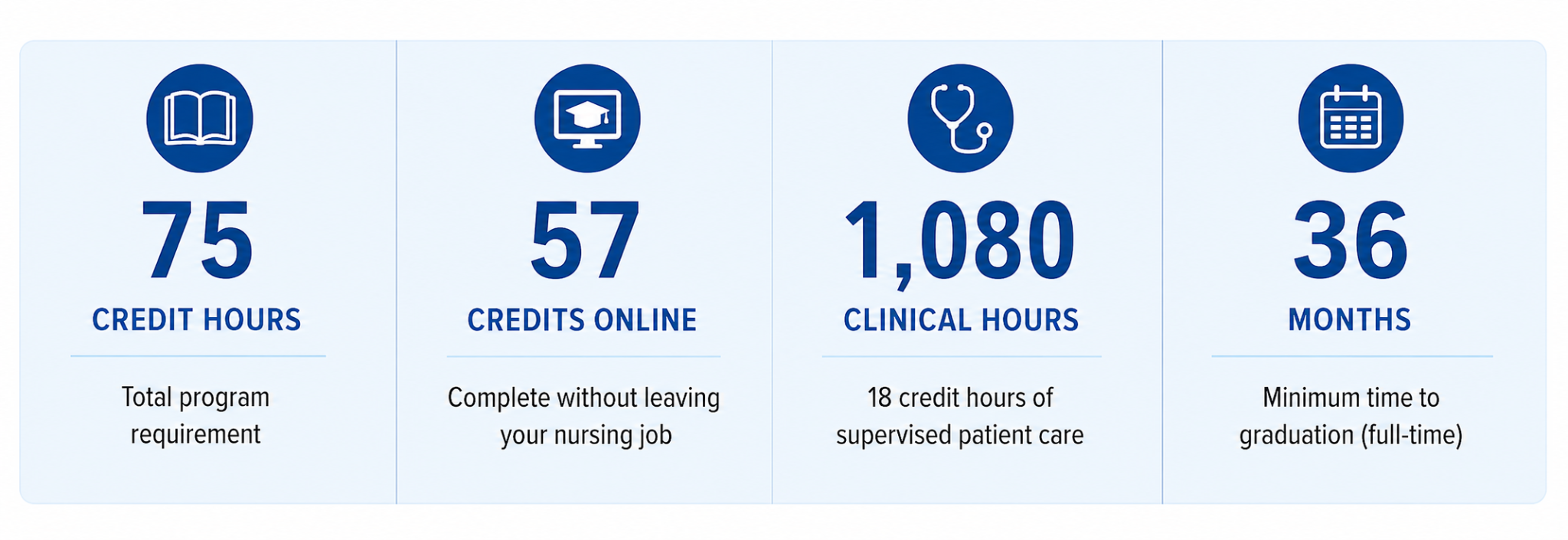
First, make sure that the program you select offers plenty of opportunities for clinical practice and direct patient care. This will allow you to put the theories and concepts you learn in class into real-world practice. In Nebraska Methodist College's (NMC) BSN to DNP program, students complete 1,080 contact hours (18 credit hours) in clinical practice specifically.
Evidence-Based Practice and Research Integration
A BSN to DNP program should also incorporate evidence-based practice and proven research. This is the best approach to patient care that empowers nurses to use currently available research and evidence to make the most informed decisions on behalf of patients.
Benefits of Achieving Full Practice Authority as an FNP
With more states offering FPA to NPs, both nurses and the community can benefit in a number of ways.
Improved Access to Care
First, empowering FNPs with the same level of autonomy as a physician can improve access to healthcare services, especially in rural areas and other underserved areas where options for healthcare may be limited. With better access to care, it is possible to improve the health and wellness of entire populations.
Increased Professional Autonomy and Career Growth
When FNPs can diagnose, treat, read diagnostic tests, and even prescribe medications, they can exercise a greater sense of professional autonomy and build their confidence as nursing professionals. This increased level of responsibility and experience can, in turn, prepare them for future career growth as they move into more advanced healthcare and even leadership roles.
Is a BSN to DNP Program Right for You?
This pathway is a strong fit if you can answer yes to most of the following:
- You hold a BSN and are ready to pursue a terminal nursing degree
- You want to practice as a Family Nurse Practitioner with clinical autonomy
- You are in or planning to move to a full or reduced practice authority state
- You want to earn your degree while continuing to work as a nurse (57 of 75 credit hours are online)
- You're prepared for a 36-month full-time commitment or a longer timeline part-time
- You're interested in contributing to your own scholarly doctoral project that advances the profession
- You see yourself eventually in a primary care provider, leadership, or healthcare policy role
Explore Our BSN to DNP Program: Built for Working Nurses
NMC's BSN to DNP - Family Nurse Practitioner program is designed specifically for nurses who cannot step away from their careers to earn a terminal degree. Here's what that looks like in practice:
- 75 total credit hours: 57 completed online, 18 dedicated to supervised clinical practice
- 1,080 clinical contact hours in real patient care settings, not simulations
- Graduate in as little as 36 months with full-time enrollment
- No GRE required for admission
- CCNE-accredited: the credential recognized by employers, licensing boards, and FPA states
- Focus on provider-patient interaction built specifically for FNP practice, not a generic DNP track
- On graduation, eligible to sit for FNP certification and practice in states with full practice authority
Ready to take the next step? Contact NMC Admissions to discuss your background, goals, and the program that's the right fit or apply now to get started.
